
From Excel chaos to competitive advantage: established processes as the perfect foundation for B2B portals

Philipp
March 11, 2026
TL;DR: From Excel business logic to automated B2B portal
Manual data entry and endless Excel spreadsheets can seem archaic. You know it, and so do we. These outdated methods eat up to 40% of your workday, cause errors, and push even the most motivated employees and partners to their limits. But this is actually where your greatest treasure lies:
Validated Logic: If a process is "painful" to perform manually due to its repetitive nature, then its content has likely already been thoroughly tested. This means that the blueprint for your software is already in place.
The Lever: We transform these "battle-tested" processes into customized B2B portals.
The Result: Higher margins, happier customers, and employees who finally have time for what matters again instead of spending it typing up PDFs and emails.
In short: We don't just digitize the status quo; we transform administrative obstacles into competitive advantages.
Studies show that employees spend a significant portion of their workday on manual, repetitive tasks such as data entry, document maintenance, and Excel spreadsheet management, rather than focusing on more strategic activities. „Over 40 % of workers spend at least a quarter of their work week on manual, repetitive tasks“. These manual processes are time-consuming and prone to errors, which can slow down decision-making. This often affects employee satisfaction and efficiency, as employees spend a large part of their workday on routine tasks they would like to automate. „Nearly 60 % of workers estimate they could save six or more hours per week if repetitive aspects were automated“.
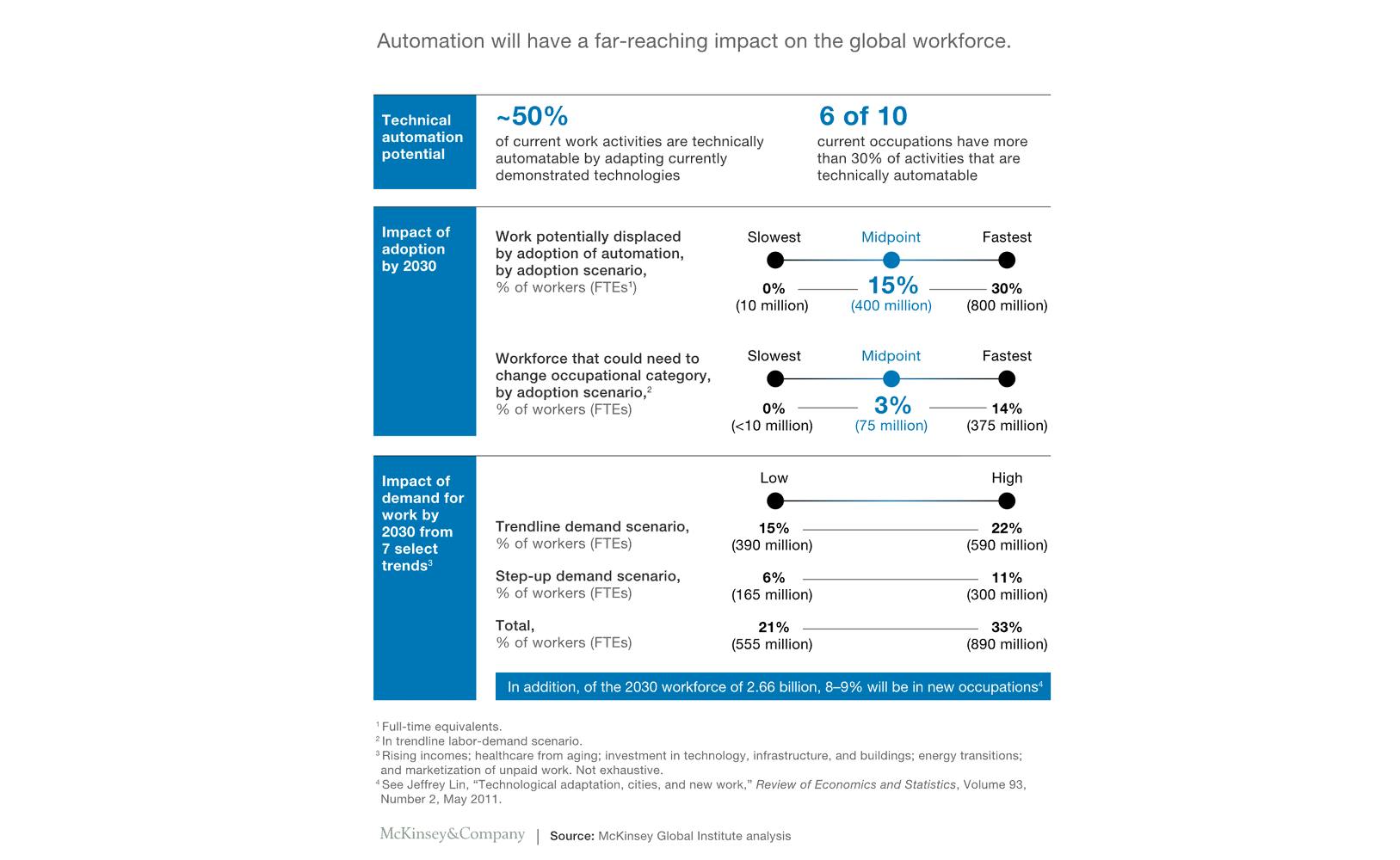
Although the original McKinsey study dates back to 2012, it is constantly updated. The most recent update was in 2024. Source: McKinsey
For us, this is usually the best starting point. Why? Because the most difficult part of the work, process validation, has often already been done. Those who come to us wanting B2B software development usually have processes that work in principle; they just haven't been technically optimized yet.
The hidden treasure in your manual processes
The processes your teams deal with every day are battle-tested. Excel lists have been maintained for years. Data has been manually entered into the ERP system. Content has been copied from PDFs and compared with CRM data. This sounds like tedious manual work, and it is. However, this is precisely where enormous potential lies. Employees often spend several hours a week on manual data entry, which results in high annual costs and increases the risk of burnout. There is interesting data on this topic from the US, for example. “Manual data entry costs U.S. companies $28,500 per employee annually and over half of employees report burnout.” However: This also means that the "data structure" behind it is often very clear. You know exactly which data is leading, who needs which information, when they need it, and what the result must be. The logic is there. However, scalability and relief for the people operating these machines are lacking.
Where does digital transformation have the greatest impact?
Experience shows that three types of companies benefit the most from transferring manual processes to a customized B2B portal:
1. Companies with a high commodity share
When moving goods with low margins but high volumes, every percentage point of efficiency counts. The greater the proportion of commodities, the more manual administrative effort is required. This is especially true with smaller quantities, where the administrative effort often eats into profits.
The Lever: A high degree of administrative automation reduces the team's workload and directly impacts profits positively.
2. Companies that have high standards for customer and partner satisfaction.
If your competitive advantage lies not only in price, but also in service, then the administrative process becomes part of the product. Laborious communication via email, back-and-forth Excel list exchanges, and phone follow-ups are opaque and slow.
The Lever: A B2B portal provides direct access to information. Transparency builds trust and strengthens the sense of partnership between equals. With a B2B portal, your customers and partners can "do" instead of "asking."
3. Companies that focus on employee satisfaction and effectiveness.
An increasing number of companies recognize that employee satisfaction hinges on how effectively and efficiently people can work. Constant media breaks, manual transfers, and repetitive tasks can hinder motivation, even if the process works technically. Employees become frustrated when they spend a large part of their time on administrative manual work. This is not because the work is unimportant, but because it can be avoided.
The Lever: A high degree of automation reduces friction losses, strengthens the sense of self-efficacy, and establishes efficient processes as a factor in employee retention and employer attractiveness. Digital transformation affects not only the cost structure, but also engagement, performance, and retention.
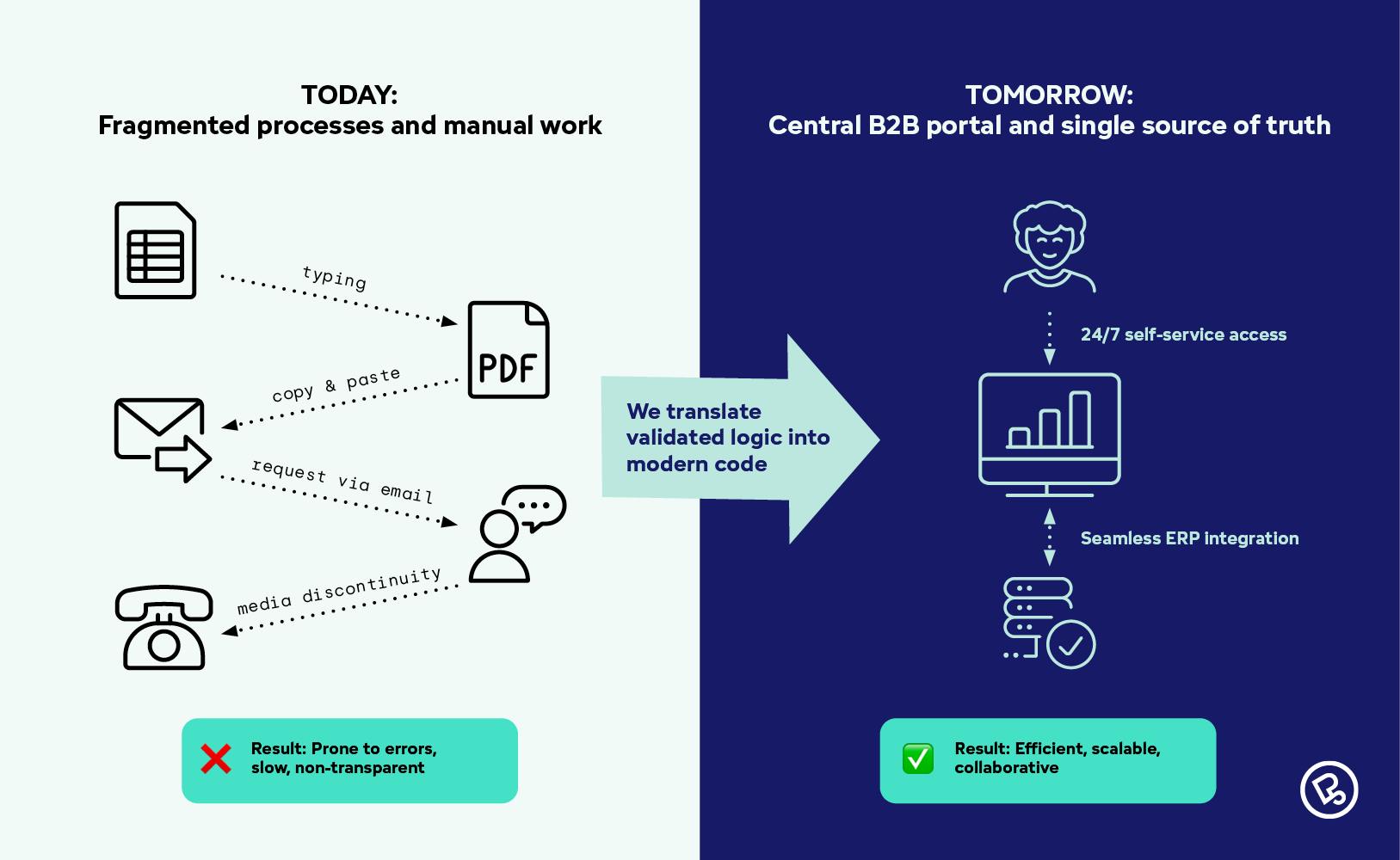
An example of how laborious and fragmented processes can be transformed into a central B2B portal.
The challenge: From process to software
For many agencies, the hurdle often lies not in the technology, but in understanding. To map established processes efficiently in software, you must first understand them thoroughly. This is where our approach comes in. We don't just want to recreate your Excel spreadsheets. The added value lies in automating beyond current user behavior, improving the user experience (UX) fundamentally, and increasing efficiency by reducing interfaces, for example. Our goal is not only to digitize the present, but also to prepare for future user experiences.
Case Study: The supplier portal
The following practical example from our work illustrates this potential: One of our customers asked us to develop a B2B portal that would provide their suppliers with more autonomy and reduce administrative overhead.
The problem:
Data had to be tediously managed in a shared Excel spreadsheet. It was difficult to track forecasts for goods availability in the warehouse.
Die solution:
We developed a portal that enables suppliers to enter and manage their own container shipments.
The success factors
- OpenAPI is a standardized exchange format that can be seamlessly integrated into our primary technology, TypeScript, for API client generation and schema validation.
- The ERP hub is the daily business of the customer. However, there is a desire to give producers a "simple" view of the data.
- High willingness to develop AI-enabled technology to fully exploit its potential.
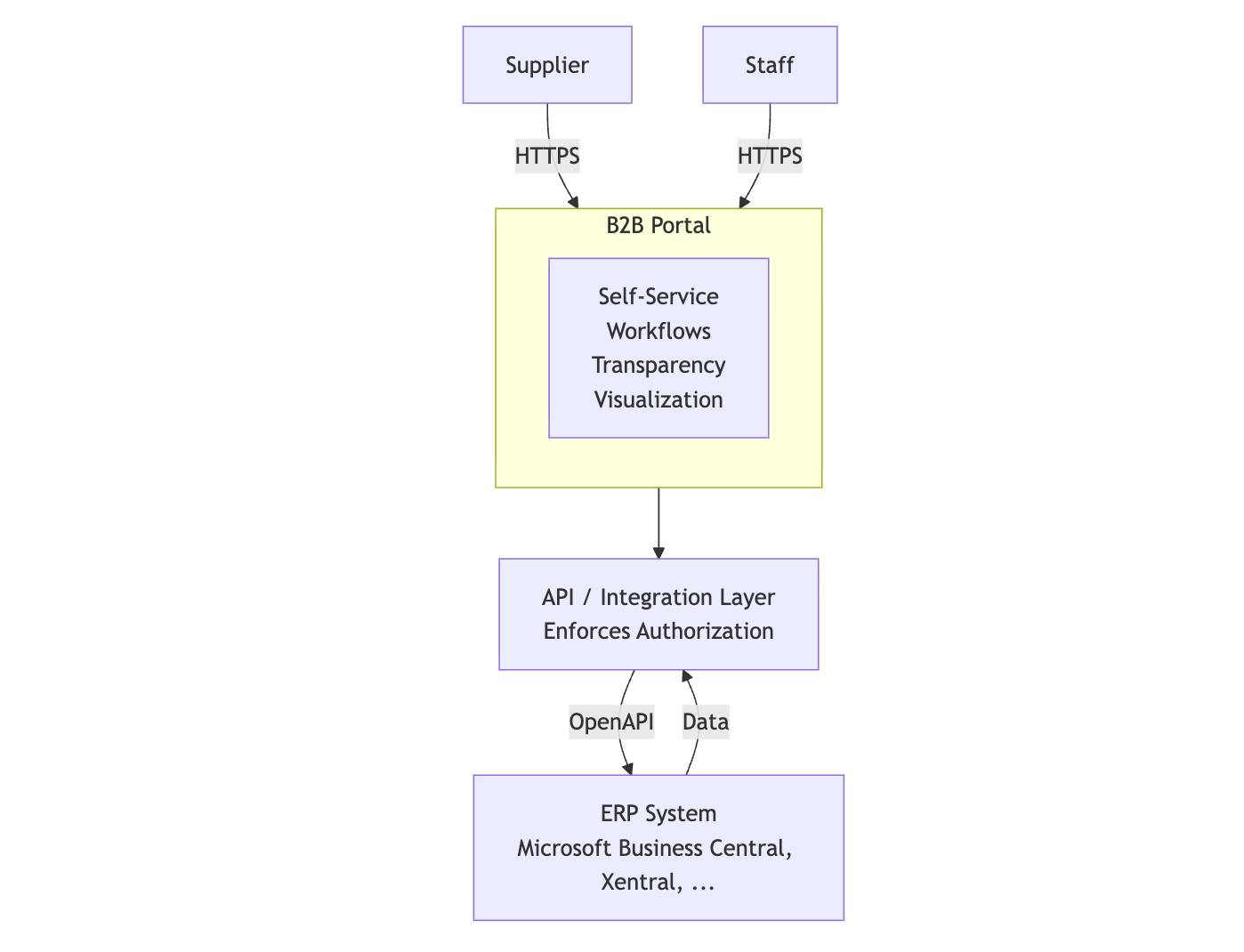
Schematic structure of a simple B2B portal
The result:
Data is now imported directly into Microsoft Business Central via an Azure function. This eliminates manual transfer errors, provides full transparency for both parties, and significantly improves planning capabilities in the warehouse.
Conclusion: Do you have processes that work but “hurt”?
Then, you have already accomplished the most important part. The next step is not a leap into the unknown. Rather, it is the logical evolution of your proven structures into a modern software architecture.

Does this resonate with your own processes?
If you're interested in going digital, please feel free to contact us. We'll find a practical way to make it happen.
Digital Transformation
Process Automation
Data Management
Custom Software Development
Business Process Digitization
Read also

Irena, 03/11/2026
Robotics in Balance: How digital solutions make physical processes smarter
Industry 4.0
Digital process optimization
Data visualization
Modular robotics solutions
Automation
Predictive maintenance
Smart Factory Software

Niklas, 03/09/2026
Are Passkeys Ready for Prime Time? – The Security Perspective (Part 1)
Passkeys
Passwords
Passwordless Authentication
Public-Key Cryptography
Challenge-Response Authentication

Nick, 01/19/2026
The Measurement Gap: Why Tracking Energy in Serverless Is So Hard
Green Coding
Green IT
Carbon Footprint
Sustainability
Energy Tracking
Cloud Efficiency
Serverless Energy Usage